Age range
3 years
Development benefits
- Fine Motor skills: Strengthens finger muscles and enhances visual-motor precision during paper crease alignment and folding.
- Sequential & Spatial reasoning: Builds an early understanding of geometric transformations, turning 2D flat surfaces into 3D structural forms.
- Focus & Precision: Extends attention span, patience, and meticulous observation necessary for multi-step task completion.
Take place in
Indoor play areas (activity table, study desk, or quiet room corner).
How to play
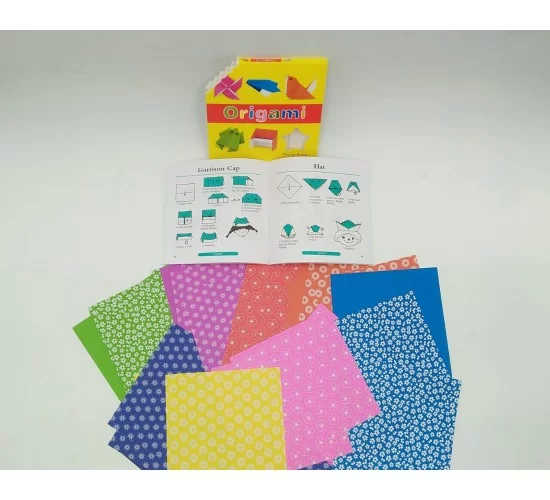
- Choose an entry-level design from the 69 available paper models.
- Hold a paper sheet and follow the step-by-step folding instructions, carefully aligning the paper edges.
- Press down gently along the creases to shape the sheet into a completed 3D paper model.
Perfect for
- Thinker & Creator: Discovering geometric symmetry and exploring transformation through paper art.
- Mover: Refining delicate finger movements, edge precision, and tactile pressure control.
Expert tip
Paper folding naturally bridges visual math with spatial planning. As a child transforms a 2D sheet into a 3D object, they actively engage both brain hemispheres in "Spatial Visualization." This process builds working memory and sequential planning skills, forming early cognitive foundations for geometry and structural thinking.